

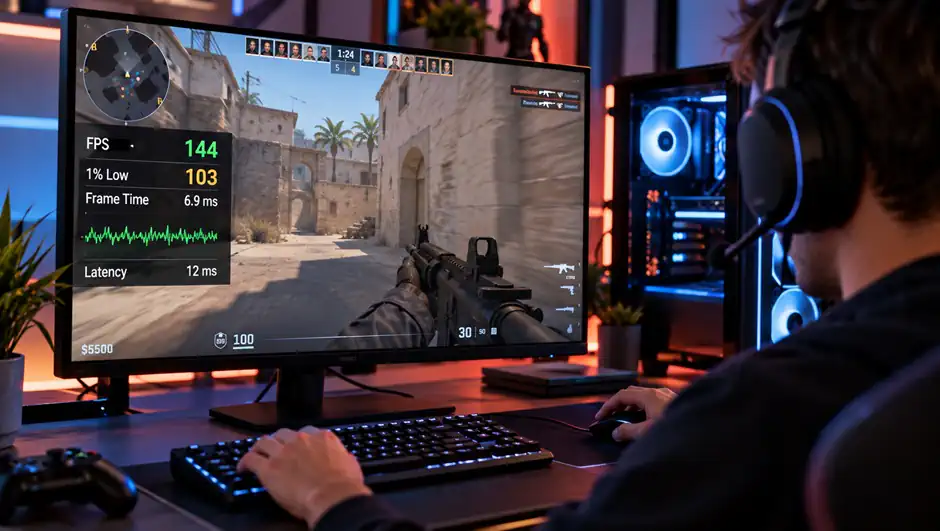
A high FPS counter does not always mean the game feels smooth.
At 120 FPS, each frame has about 8.3 milliseconds to arrive. That sounds comfortable until a few frames suddenly take 25 or 30 ms. The average hardly notices. The player does.
That difference is easy to miss from the outside. Someone following an esports match and its markets through vippari may see the score, player form and match progress, while a frame-time problem remains confined to the player’s own system. For the player, 1% lows and latency can matter more than the headline FPS number.
A lower average can still be the better result
1% lows are useful because they catch the slower part of a run.
Different benchmark tools calculate them in slightly different ways, so direct comparisons need the same method. The principle is simple enough.
One system might average 140 FPS with a 1% low of 55 FPS. Another might sit at 125 FPS with a 1% low of 105 FPS.
The first looks faster on paper. The second spends far less time falling away from its average.
Frame-time graphs usually make that obvious. A busy CPU scene can create a spike. Asset streaming can create another. Background software sometimes shows up there too.
Online games bring their own complications. Anti-cheat processes run alongside the game. Player counts can shift quickly. At high refresh rates, a short hitch during a peek is easier to feel than the average FPS suggests.
Reflex can help a lot, or barely at all
Frame pacing and system latency are not the same problem.
NVIDIA Reflex cuts down queued work between the CPU and GPU. AMD Anti-Lag 2 targets a similar part of the chain through game integration.
The gain is not fixed.
In recent GameGPU testing, Fortnite at 4K with native DLAA dropped from 62 ms to 30 ms of measured system latency with Reflex enabled.
Counter-Strike 2 told a different story. At 1080p, latency moved from 3.8 ms to 3.2 ms.
CS2 was already running at a very high frame rate, so there was less delay left to remove.
Frame generation makes the picture less tidy. DLSS and FSR can add intermediate frames and raise the displayed FPS. Those extra frames are not new simulation updates.
NVIDIA therefore combines DLSS Frame Generation with Reflex. AMD recommends Anti-Lag 2 when FSR Frame Generation is active.
The FPS counter can rise faster than responsiveness does.
One number is rarely enough
For online play, four measurements tend to be more useful together:
- average FPS for overall throughput;
- 1% lows for the slower part of the run;
- frame-time graphs for visible spikes;
- system latency when reliable measurement is available.
The balance changes by game.
A large MMO fight may lean heavily on the CPU. An extraction shooter can expose a different bottleneck. A small competitive arena may stay much cleaner on the same hardware.
CapFrameX, RTSS and built-in overlays help show whether a hitch keeps returning or only appears in one scene.
A frame cap below the sustainable maximum can also help. VRR may smooth delivery further. Reflex or Anti-Lag deals with another part of the problem.
Esports markets only notice technical trouble once it becomes visible
A private frame-time graph does not set an esports price.
Markets react to the match itself. Team form matters. Map selection matters. Player availability often matters more.
Technical issues enter the picture once they affect play.
Someone following markets through vippari indir may see a technical pause or restart during a map. A hardware failure can force a substitution.
An unseen 1% low on one machine is different. If it never reaches the competition, it has little value outside the player’s own setup.
The stronger run is usually the steadier one
Competitive players often lower settings at 1080p to protect base frame rate. The gain is not always a larger peak. Sometimes it is simply fewer bad frames.
That can leave a mid-range GPU feeling better than a faster card in one particular game if the faster setup produces larger spikes.
Peak FPS still matters. It just becomes less convincing once the frame-time graph starts telling a different story.